
Microsoft Fabric Data Pipeline
The Microsoft Fabric Data Pipeline has become one of the most essential components in the modern analytics ecosystem. As organizations move toward unified data platforms, the need for a streamlined, scalable, and automated data pipeline becomes even more important. Microsoft Fabric provides an end-to-end analytics environment that brings together data engineering, data integration, real-time processing, predictive analytics, governance, and business intelligence. At the core of this environment, the Microsoft Fabric Data Pipeline plays a critical role in connecting data from multiple sources and preparing it for analytics and decision-making.
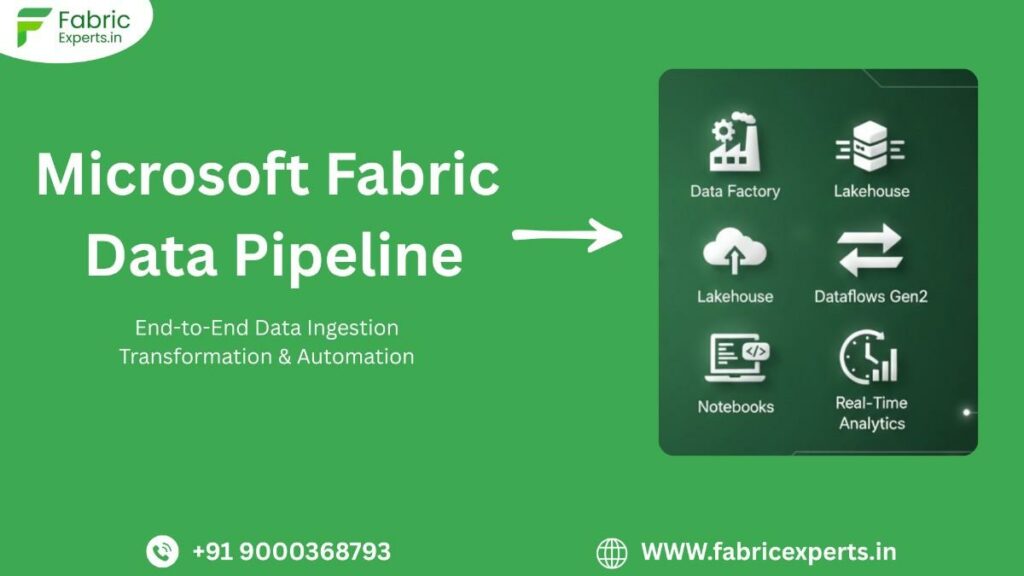
What Is a Microsoft Fabric Data Pipeline?
A Microsoft Fabric Data Pipeline is an end-to-end workflow designed to ingest, process, transform, and deliver data within the Microsoft Fabric ecosystem. It connects multiple data sources, integrates them into Fabric workloads, and ensures that data moves smoothly from raw form to analytics-ready output. The Microsoft Fabric Data Pipeline eliminates the need for several disjointed tools by offering a unified approach to data engineering, orchestration, and management.
Unlike traditional ETL or ELT systems that depend on separate services for storage, transformation, and analytics, the Microsoft Fabric Data Pipeline centralizes all activities within a single platform. This is possible because Fabric integrates all workloads Data Factory, Data Engineering, Data Warehouse, Real-Time Analytics, and Power BI under one environment powered by OneLake. As a result, the Microsoft Fabric Data Pipeline fosters a seamless data lifecycle.
The primary purpose of the Microsoft Fabric Data Pipeline is to provide a reliable, scalable, and efficient mechanism for handling enterprise data. Whether the requirement is batch ingestion, streaming ingestion, real-time processing, or advanced transformation, the Microsoft Fabric Data Pipeline supports a wide range of data-driven scenarios. Organizations rely on these pipelines to maintain consistency, quality, and accessibility across their analytical systems.
Why Microsoft Fabric Data Pipeline Is Important
Understanding the importance of the Microsoft Fabric Data Pipeline requires looking at the limitations organizations have traditionally faced in their data ecosystems. Earlier data architectures depended on multiple disconnected systems that made the analytics lifecycle slow, complex, and expensive.
In legacy environments, companies often worked with:
- Disconnected ingestion tools
- Separate transformation engines
- Multiple storage systems
- Different reporting tools
- Independent governance frameworks
Because every component operated in isolation, organizations struggled with several issues such as data silos, inconsistent formats, repetitive processes, complex maintenance, and long delivery cycles. These fragmented systems also created higher operational costs, making analytics less efficient and less scalable.
The Microsoft Fabric Data Pipeline solves these long-standing challenges by providing a unified data platform where ingestion, transformation, monitoring, orchestration, governance, and analytics work together seamlessly. By consolidating all workloads into one ecosystem, the Microsoft Fabric Data Pipeline eliminates the need for multiple tools and reduces architectural complexity.
This unified approach ensures that teams can build workflows faster, maintain systems more reliably, and analyze data more effectively. Because the Microsoft Fabric Data Pipeline operates on top of OneLake, all ingested data becomes instantly available across the Fabric environment without duplication. This improves performance, ensures consistency, and enhances collaboration among data engineering, analytics, and BI teams.
In modern data-driven organizations, the Microsoft Fabric Data Pipeline plays a critical role by enabling real-time insights, simplifying cloud adoption, supporting advanced analytics, and ensuring governance at scale. Its importance continues to grow as businesses move toward unified analytics, AI-driven decision-making, and cloud-first strategies.
Key Features of Microsoft Fabric Data Pipeline
The Microsoft Fabric Data Pipeline offers a powerful set of features designed to support modern analytics, streamline workflows, and simplify complex data operations. These features make the platform suitable for organizations of all sizes that rely on continuous, scalable, and unified data processing.
Unified Ingestion
One of the most important features of the Microsoft Fabric Data Pipeline is its ability to ingest data from a wide range of sources. Microsoft Fabric provides connectors for cloud platforms, on-premises databases, file systems, web APIs, SaaS applications, and third-party tools. This flexibility ensures that the Microsoft Fabric Data Pipeline can support diverse enterprise environments without requiring additional external tools or complex integrations.
No-Code and Low-Code Development
TheMicrosoft Fabric Data Pipeline offers a user-friendly, drag-and-drop interface that allows users to create workflows without writing code. At the same time, advanced developers can incorporate custom scripts for deeper transformation logic. This hybrid approach enables both beginners and experts to use the Microsoft Fabric Data Pipeline effectively, making it accessible across different skill levels in an organization.
Integration with OneLake
A major advantage of the Microsoft Fabric Data Pipeline is its seamless integration with OneLake, the unified data lake of Microsoft Fabric. All pipelines load data directly into this centralized storage layer. Because OneLake supports the Delta Lake format, the Microsoft Fabric Data Pipeline ensures reliable, consistent, and high-performance storage access across all workloads.
Built-In Orchestration
The Microsoft Fabric Data Pipeline includes native orchestration capabilities such as scheduling, error handling, retry mechanisms, and monitoring. Users can choose whether to run pipelines manually, schedule them at specific intervals, or trigger them based on events. This built-in orchestration reduces dependency on external tools and ensures that workflows run smoothly and predictably.
Scalability and Performance
The Microsoft Fabric Data Pipeline is cloud-native and designed to scale automatically based on workload requirements. Whether processing small datasets or onboarding terabytes of information, the pipeline maintains consistent performance. Its distributed, elastic architecture ensures that organizations can grow without worrying about infrastructure limitations.
Integration with Other Workloads
A critical benefit of the Microsoft Fabric Data Pipeline is its tight integration with other Fabric workloads, including:
- Lakehouses
- Data Warehouses
- Kusto databases
- Power BI semantic models
- Notebooks
- Dataflows
This interconnected environment allows the Microsoft Fabric Data Pipeline to support complete end-to-end analytics workflows from raw ingestion to reporting and advanced data science within a single unified platform. The result is improved efficiency, stronger governance, and faster insight generation.
How Microsoft Fabric Data Pipeline Works
The Microsoft Fabric Data Pipeline operates through a structured sequence of stages that reflect modern data engineering standards. Each stage ensures that data flows smoothly from ingestion to analytics, all within a unified Fabric environment. Understanding how the Microsoft Fabric Data Pipeline works helps teams design reliable, scalable, and efficient workflows.
Data Ingestion
The first step of the Microsoft Fabric Data Pipeline is data ingestion. This stage focuses on extracting data from multiple structured, semi-structured, and unstructured sources. Microsoft Fabric provides connectors for a wide range of systems, including SQL Server, Oracle, Snowflake, AWS services, REST APIs, Azure data sources, and on-premises environments.
The ability to pull data from diverse platforms makes the Microsoft Fabric Data Pipeline suitable for enterprises with complex and distributed data landscapes.
Data Transformation
After ingestion, the Microsoft Fabric Data Pipeline moves into the transformation phase. Using Dataflows, Spark notebooks, SQL queries, and built-in transformation activities, raw data is converted into meaningful, analytics-ready formats.
Common transformation tasks include:
- Cleansing
- Validation
- Aggregation
- Mapping
- Modeling
This ensures that the output of the Microsoft Fabric Data Pipeline is accurate, consistent, and ready for downstream analytics.
Data Loading
Once the data is transformed, the Microsoft Fabric Data Pipeline loads it into target environments such as Lakehouses, Data Warehouses, or Real-Time Analytics systems.
Because Microsoft Fabric integrates directly with OneLake, the unified storage layer, data loading becomes efficient and avoids unnecessary duplication. This is one of the main strengths of the Microsoft Fabric Data Pipeline, as it promotes a single-source-of-truth architecture.
Orchestration and Automation
A key feature of the Microsoft Fabric Data Pipeline is its powerful orchestration engine. Users can design multi-step workflows that run automatically based on schedules, triggers, or dependencies.
Automation ensures that data is refreshed on time, enabling consistent delivery of analytics and reducing manual intervention. This makes the Microsoft Fabric Data Pipeline highly reliable for enterprise operations.
Monitoring
The final stage involves monitoring and performance tracking. The Microsoft Fabric Data Pipeline includes built-in tools that provide insights into run history, execution status, failure points, performance metrics, and optimization opportunities.
By offering detailed visibility, the Microsoft Fabric Data Pipeline helps teams maintain high-quality operations and quickly address issues when they arise.
Components Involved in Microsoft Fabric Data Pipeline
Understanding the main components involved in the Microsoft Fabric Data Pipeline provides clarity on how the platform supports diverse analytics workloads. Each component plays a specific role in ingestion, transformation, storage, and reporting, enabling end-to-end data processing in a unified environment.
OneLake
OneLake is the unified storage foundation for the Microsoft Fabric Data Pipeline. All ingested and transformed data is stored in OneLake, eliminating silos and ensuring a single-source-of-truth. Because OneLake uses an open Delta Lake format, the microsoft fabric data pipeline benefits from high performance, reliability, and compatibility across workloads.
Data Factory
Data Factory is one of the core engines behind the Microsoft Fabric Data Pipeline. It provides a wide range of connectors, ingestion activities, mapping dataflows, and orchestration tools. Data Factory helps users design automated workflows that extract, transform, and load data into Fabric storage. It is essential for scalable and repeatable pipeline execution.
Synapse Data Engineering
Synapse Data Engineering supports large-scale data processing using Apache Spark. When workloads require heavy transformations, advanced modeling, or distributed computation, the Microsoft Fabric Data Pipeline uses Spark notebooks and jobs to process the data efficiently. This is particularly useful for big data scenarios.
Synapse Data Warehousing
For structured and SQL-based workflows, Synapse Data Warehousing powers the analytical layer of the Microsoft Fabric Data Pipeline. It enables scalable SQL analytics, schema-based storage, and optimized query performance. Pipelines can load data into warehouses to support enterprise reporting and analytical modeling.
Power BI
Power BI plays a crucial role in consuming and visualizing the data delivered through the Microsoft Fabric Data Pipeline. After the pipeline processes and loads data into Lakehouses, Warehouses, or semantic models, Power BI builds dashboards and reports. This ensures that business teams receive real-time, accurate insights.
Dataflows
Dataflows provide lightweight transformation capabilities using Power Query. For scenarios that do not require heavy Spark processing, the Microsoft Fabric Data Pipeline can leverage Dataflows for cleansing, shaping, and preparing data. This approach is ideal for business users and self-service analytics.
Benefits of Microsoft Fabric Data Pipeline
The Microsoft Fabric Data Pipeline delivers a wide range of benefits that help organizations streamline their analytics processes, reduce operational complexity, and improve data-driven decision-making. Its unified architecture allows teams to build, manage, and scale pipelines without relying on multiple disconnected systems. Below are the major advantages of using a Microsoft Fabric Data Pipeline in modern data environments.
Simplified Architecture
One of the biggest advantages of the Microsoft Fabric Data Pipeline is its simplified architecture. Traditionally, organizations required separate tools for ingestion, transformation, orchestration, storage, and analytics. With Fabric, all these capabilities are available in one integrated platform. This reduces complexity and makes it easier for teams to design end-to-end workflows.
Faster Delivery
The Microsoft Fabric Data Pipeline accelerates development cycles by offering unified features, built-in connectors, and no-code or low-code components. Because teams do not need to integrate multiple services manually, pipelines can be built and deployed much faster. This leads to quicker insights and supports time-sensitive decisions.
Lower Costs
By eliminating tool sprawl and consolidating analytics workloads into a single environment, the Microsoft Fabric Data Pipeline significantly reduces license and infrastructure expenses. The unified storage layer in OneLake also lowers storage duplication costs and helps organizations avoid maintaining multiple systems.
Better Collaboration
A major benefit of the Microsoft Fabric Data Pipeline is enhanced collaboration. All teams data engineers, analysts, data scientists, and governance specialists work within the same environment. Shared workspaces, shared storage, and consistent data models allow seamless teamwork across departments.
High Data Quality
The Microsoft Fabric Data Pipeline includes built-in validation, monitoring, and governance features. These capabilities help ensure that data entering the system is accurate, complete, and compliant with organizational standards. Automated quality checks lead to more reliable analytics and trustworthy business reporting.
Future-Ready Analytics
The Microsoft Fabric Data Pipeline is designed for next-generation analytics. It supports AI-powered insights, real-time processing, machine learning workloads, and advanced modeling. This future-ready architecture ensures that organizations can adapt quickly as technology evolves, especially in cloud-first and AI-first environments.
Real-World Use Cases of Microsoft Fabric Data Pipeline
The Microsoft Fabric Data Pipeline is widely used across industries to automate critical workflows, improve operational efficiency, and support data-driven decision-making. Its ability to unify ingestion, transformation, orchestration, and analytics makes it suitable for a variety of real-world scenarios. Below are some of the most impactful use cases where the Microsoft Fabric Data Pipeline delivers value.
Customer Analytics
Retail and e-commerce companies use theMicrosoft Fabric Data Pipeline to consolidate customer interactions, behavior patterns, purchase histories, and engagement data. By centralizing this information, businesses gain a complete customer view that supports personalization, retention strategies, and targeted marketing.
Financial Reporting
Banks, financial institutions, and corporate finance teams rely on the Microsoft Fabric Data Pipeline to centralize transactional data, ledger entries, risk metrics, and regulatory information. The unified workflow helps reduce manual reporting effort, improve accuracy, and accelerate financial close cycles.
Supply Chain Management
Manufacturing organizations use the Microsoft Fabric Data Pipeline to track suppliers, shipments, warehouse operations, logistics, and inventory levels in real time. With continuous updates flowing through the pipeline, companies can optimize supply chain performance and detect bottlenecks early.
Healthcare Analytics
Hospitals and healthcare systems use the Microsoft Fabric Data Pipeline to manage patient records, diagnostic information, clinical workflows, and operational metrics. This improves decision-making across patient care, resource allocation, and healthcare administration while maintaining data quality and compliance.
Marketing Intelligence
Marketing teams use the Microsoft Fabric Data Pipeline to automate performance tracking for campaigns, web analytics, leads, and audience segments. The centralized structure allows marketers to measure KPIs more accurately and react faster to changing trends.
IoT and Real-Time Analytics
Organizations working with IoT devices, sensors, and telemetry use the Microsoft Fabric Data Pipeline to ingest real-time data and update dashboards instantly. This is especially useful in industries such as manufacturing, smart cities, energy, and transportation, where immediate action is critical.
Microsoft Fabric Data Pipeline Architecture
The architecture of a Microsoft fabric data pipeline typically includes:
- Source systems (databases, cloud services, files, APIs)
- Ingestion layer (Data Factory activities)
- Transformation layer (SQL, Spark, Dataflows)
- Storage layer (OneLake)
- Consumption layer (Power BI, AI models, applications)
- Governance layer (security, auditing, permissions)
This architecture supports the entire data lifecycle, ensuring consistency and reliability.
Challenges in Microsoft Fabric Data Pipeline
Even with its advantages, the Microsoft Fabric Data Pipeline may face challenges:
Complex Data Sources
Some legacy systems require custom connectors.
Large-Scale Transformations
Heavy workloads may need Spark cluster optimization.
Governance Requirements
Enterprise governance may demand strict compliance rules.
Skill Gaps
Organizations may need skilled engineers to build efficient pipelines.
Best Practices for Building Microsoft Fabric Data Pipeline
Following best practices improves performance and reliability:
Design Modular Pipelines
Break pipelines into smaller tasks to enhance maintenance.
Use Delta Format
Delta Lake format ensures better performance in OneLake.
Optimize Transformations
Push transformations closer to ingestion where possible.
Use Parameterization
Reusable pipelines save development time.
Monitor Pipelines
Regular monitoring prevents delays and failures.
Secure Access Properly
Use RBAC and governance tools to protect sensitive data in the Microsoft Fabric Data Pipeline
Future of Microsoft Fabric Data Pipeline
The future of the Microsoft Fabric Data Pipeline looks strong as organizations move toward AI-first and cloud-first strategies. Key trends include:
- Greater automation using AI
- Expansion of real-time analytics
- More advanced connectors
- Better integration with machine learning models
- Improved governance features
As these trends grow, the Microsoft fabric data pipeline will play an even more essential role in helping businesses transform raw data into meaningful insights.
Conclusion
The Microsoft Fabric Data Pipeline is a crucial component in the modern analytics world. It enables organizations to connect data sources, automate workflows, transform information, and deliver insights across the enterprise. With its unified architecture, powerful connectors, built-in governance, and scalable cloud infrastructure, Microsoft Fabric simplifies the entire analytics journey. As businesses continue adopting unified data platforms, the demand for efficient and reliable Microsoft Fabric Data Pipeline solutions will continue to increase.
FAQ's
1. What is a Microsoft fabric data pipeline?
A microsoft fabric data pipeline is an end-to-end data orchestration and processing system that helps ingest, transform, store, and deliver data across the Microsoft Fabric platform.
2. Why is a Microsoft fabric data pipeline important for modern analytics?
It simplifies data engineering, reduces tool complexity, and provides a unified environment for analytics, BI, and AI workloads.
3. What components are included in a microsoft fabric data pipeline?
It includes source connectors, Data Factory ingestion, transformation tools like SQL and Spark, OneLake storage, and Power BI or AI consumption layers.
4. How does a microsoft fabric data pipeline handle data ingestion?
It uses Data Factory activities, Copy tasks, and Dataflow Gen2 to ingest data from databases, files, APIs, and cloud sources.
5. Can a Microsoft fabric data pipeline process real-time data?
Yes, it supports streaming and real-time ingestion for IoT, telemetry, and continuous data updates.
6. What transformation options are available in a microsoft fabric data pipeline?
It uses SQL, Spark notebooks, Dataflows Gen2, and low-code ETL tools for data transformation and cleansing.
7. Where is data stored in a microsoft fabric data pipeline?
All data is stored in OneLake, the unified, scalable storage system of Microsoft Fabric.
8. Is a microsoft fabric data pipeline suitable for big data workloads?
Yes, Spark-based processing allows it to handle large-scale data engineering and analytics tasks efficiently.
9. How does a microsoft fabric data pipeline support governance?
It includes security controls, role-based access, lineage, auditing, and compliance management built into the platform.
10. Can Power BI connect directly to a Microsoft fabric data pipeline?
Yes, Power BI integrates seamlessly with Fabric pipelines, enabling real-time dashboards and analytics.
11. Does a microsoft fabric data pipeline reduce operational costs?
Yes, it eliminates multiple tools, reduces storage duplication, and lowers licensing and infrastructure expenses.
12. What industries can benefit from a Microsoft fabric data pipeline?
Industries like retail, finance, healthcare, manufacturing, and marketing heavily rely on Fabric pipelines for analytics and automation.
13. How does a microsoft fabric data pipeline improve data quality?
It provides validation rules, governance workflows, transformations, and quality checks to produce reliable data.
14. Is coding required to build a microsoft fabric data pipeline?
Not always. Users can build pipelines using low-code Dataflows Gen2 or use SQL and Spark for advanced scenarios.
15. Can a Microsoft fabric data pipeline integrate with external cloud platforms?
Yes, it supports connectivity with Amazon S3, Google Cloud Storage, and various third-party APIs.